

RESPONDUM
A Promise In Return

Earlier today, the news broke that Jane Goodall had passed away at the age of 91.


When I think of hope, one of my first thoughts is of Jane Goodall and these words:
Hope does not deny the evil,
but is a response to it.
The modern English word response finds its origins in the Latin responsum, which means to promise in return.
In other times, responsum referred to the part of a liturgy said or sung by the congregants in response to the leading voice.
Goodall’s quote inspires me in two ways.
First, responding is not about feeling something, but about doing something. As a child and teenager in church, and sometimes as an adult, I could listen to the call and response of a liturgy with no emotion beyond boredom. The response isn’t to feel anything, but to speak or sing the words, to stand or kneel, to clasp hands in prayer or raise them.
We do something.
Second, a response, a respondum, flatly denies evil the last word. When evil calls, we respond in hope. We refuse to be silent, inactive - hopeless.
We can respond by doing something.
A couple of weeks ago, I was feeling overwhelmed by the news. I measure my news intake and choose my sources carefully, but this is the world I have been given into, and it deserves my attention, but these days it can easily flood my emotions and my soul.
So I made donuts. Not cake donuts, but the hearty, sweet-bread-like donuts that my grandmother used to make. I doubled the batch and shared them with several client families.
There is nothing I can do to change the savagery I see in the news. But I can refuse to let cruelty have the last word. Where cruelty calls out, I can respondum with generous kindness.
We can respond by saying something.
Over the summer, I met with the mother of an ASD client I work with. She was tired, and she expressed to me that some days she felt like she couldn’t do anything right.
Did Sam (not the child’s real name) get up on time today? I asked.
Yes.
Did Sam have a healthy breakfast?
Most of one.
Did Sam make it to school on time, wearing clean clothes, with his backpack and lunch?
Yes.
When Sam got out of the car, did you tell him you love him?
Yes, she offered, but my house is a mess, and yesterday Sam was frustrated, and I just got frustrated right back.
I smiled. So this morning, Sam is up, fed, dressed, at school on time, and assured of your love. This afternoon, when you’re both home, you can find a moment to talk about your feelings and how they affected you yesterday. So that’s four things you’ve already done right today, and a fifth is coming this afternoon.
There is nothing I can do to end the struggle I see in my clients. But I can refuse to let the struggle have the last word. Where struggle calls out, I can respondum with perspective and patience.
We can respond by praying something.
I no longer believe in the Sunday School image of God I was taught in my childhood. The God, the Divine, that I believe in is far more complex, mysterious, and intimate. I don’t think it matters what you name that presence or being, but I do think it matters to believe in something benevolent and beautiful beyond ourselves.
In "How God Becomes Real: Kindling the Presence of Invisible Others" (Princeton University Press, 2020), Tanya Luhrmann explains that religious practices and narratives can bring about profound, positive changes in the lives of those who engage with them.
I highly recommend Luhrmann’s book!
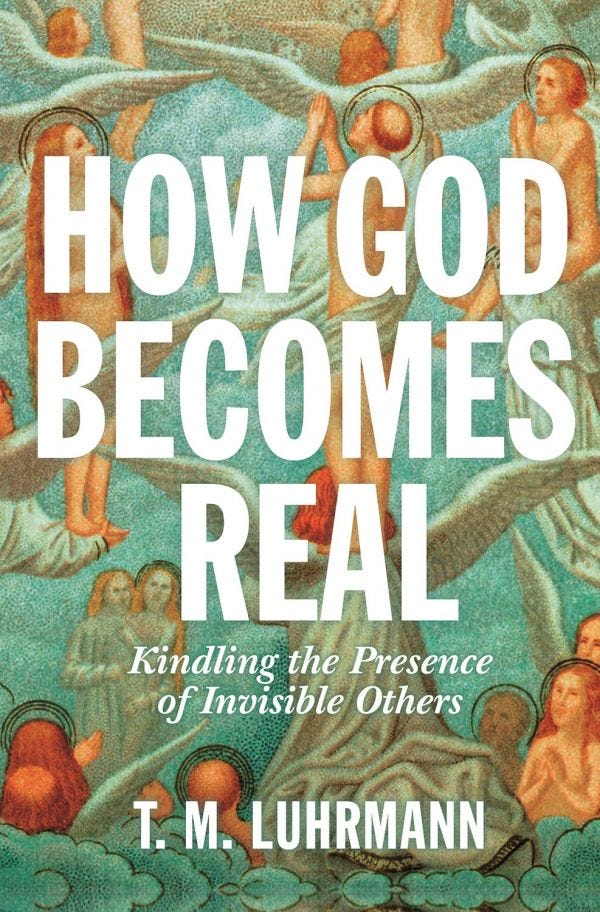
Luhrmann’s premise is grounded in two straightforward, but often overlooked, features of religion. “First, religion is a practice in which people go to effort to make contact with an invisible other. Second, people who are religious want change. They want to feel differently than they do,” she writes. “Yet instead of exploring these features, most theories of religion begin by treating belief in an invisible other both as taken for granted and as a cognitive mistake.”
According to Luhrmann, people must work hard to make supernatural beings real, and those who succeed experience beneficial changes. “If they’re lucky, they’re able to attend differently to their thoughts, feel calmer and more beloved,” she said. These positive outcomes reinforce religious practices, encouraging sustained commitment to rituals and observances.
Relying on ethnographic studies of active believers, including evangelical Christians, pagans, Zoroastrians, Black Catholics, Santeria initiates, and newly orthodox Jews, Luhrmann found that it takes considerable effort and regular practice to create worlds where supernatural others feel present and real.
Research shows emphatically that people of faith report feeling better and healthier. The scientific study of social epidemiology demonstrates that religious involvement with God is beneficial for the body in terms of immune function and reducing loneliness.
There is often nothing I can do to alleviate the deep loneliness and fears for the future that I, and so many others around the globe, carry. But I can refuse to let the loneliness and fear have the last word. Where loneliness and fear call out, I can respond by inviting the presence and sweet passions of the Divine for myself and others.
Hope,
the desire to see something better in the future
and
the willingness to act to bring it even a little closer,
does not deny evil
but is a
response
to it.
I invite you to hope with me, to do something, say something, pray something, to not let the cruelty and struggle and loneliness we see and know have the last word.
Kate
If you find value in these posts, I encourage you to share them and to become a free or paid subscriber.
Thank you.